Cute Baby, Big Brothers, and Donkeys in the Yard


Lately we’ve all seemed tired, some have had recurring headaches, and each day has had enough trouble of its own…so blogging has kind of fallen by the wayside. Here are a few photos by way of update:
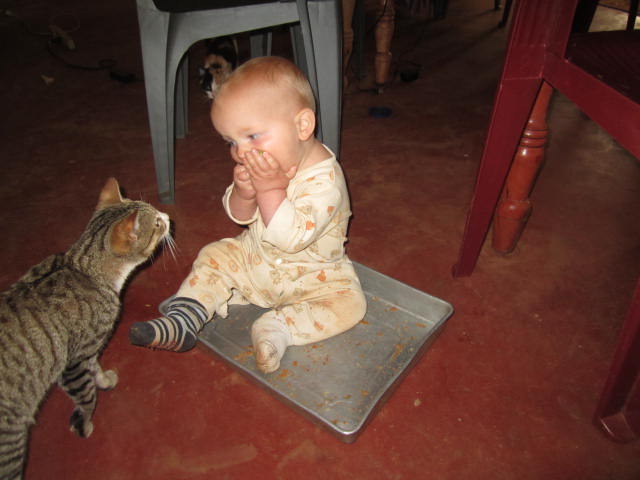
Enoch, at 15 months, keeps us all smiling. Still pretty much non-verbal (except for the occasional “Mama” or “bye,”) he still manages to communicate quite well. His loud and abrupt, “Eh!” sound usually indicates that an older sibling is provoking him in some way and he is not pleased. Enoch also has an amusing love/hate relationship with both our cats. They put up with his merciless pulling of fur because they usually end up sharing food on the floor after meals. Here, I put the pan of crumbs on the floor for the cats after we had polished off our breakfast cake–and look who ended up with the advantage!


A week or so ago, Isaiah was experimenting with molding plastic (not sure why, but it’s always one project or another). He needed some good “clay” to make a mold for the melted plastic and the soil right next to our house showed some good specimens. He set to work digging a big hole, and up toddled Enoch to “help.” He loves to copy his big brother. 🙂
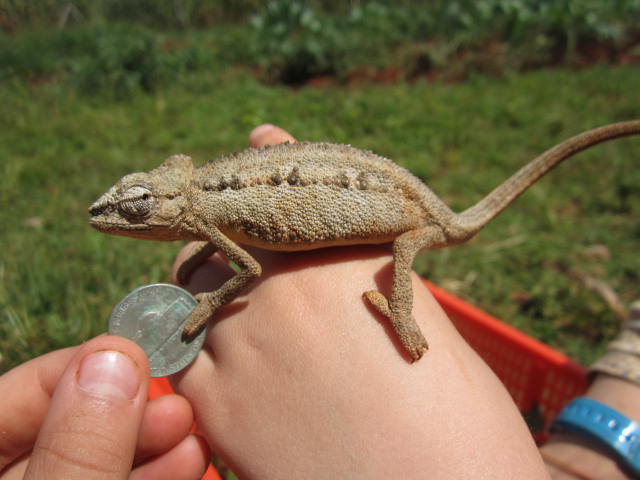
And speaking of big brothers, the entire neighborhood now knows that our 11 year-old, Jonah’s, greatest wish was to find a chameleon for a pet in Africa. As a result, he now has SIX. Here is one. He has names for them all, but I can’t keep up. He spends about an hour a day hunting for appropriate-sized flies, grasshoppers, and crickets to feed all these little guys. The locals are scared of them and believe them to be poisonous. Our neighbor, witnessing both Jonah and Rebekah handling them, said she thinks that we must be using some chemicals on our hands to be able to do that safely.
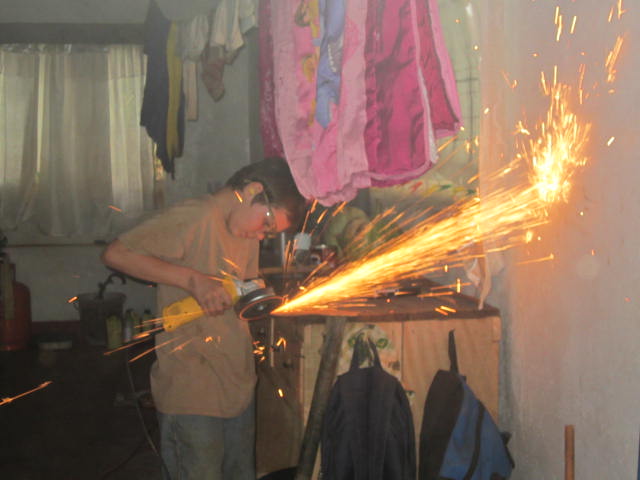
Please disregard the pretty pink princess sleeping bag hanging over Isaiah’s head here. (It started to rain before the laundry was completely dry, so we have a back-up clothesline stretched across the kitchen.) Isaiah decided to use my kitchen counter as a work bench for his new “business”–grinding jembes (hoes), slashers, pangas (machetes), axes, and knives. It puts a few shillings in his pocket, which he is excited about. We have talked at length about “business opportunities” for the boys–we don’t want to take business away from any locals, and  will allow them to pursue things that only “we” are able to do. Because we have solar power and an inverter as well as a generator–and a good grinding tool–Isaiah is able to do this work, which no one else in the area does. Jonah has been baking cakes for a couple of local shops and selling small pieces for 5 shillings each–also something that no one else does because, of course, only the mzungus have an oven!

Finally, we’ve been having a local guy (Aniga) do some various odd jobs for us, most involving working with wood. One project is to make a smaller gate in our fence (we currently have a very large and very heavy gate, which takes two people to open and close. We don’t really need one that large for foot traffic and Marc’s motor bike, which is mostly what goes in and out). Also, eventually he will be building a SWING SET for the children! (Can’t wait for this one!!) Grampy gave the kids a Wal-Mart gift card for Christmas right before we moved and we bought and shipped in our crate a few swings and all the bracketry we would need to assemble a swing set–the only thing we’ve been lacking is lumber. So that’s on the agenda, too. Anyway, recently Aniga went out to purchase some big lumber. Usually things make it home by motorbike, but the size and weight of these was just too much for a piki-piki. We were all surprised and quite amused when THIS showed up in our front yard:
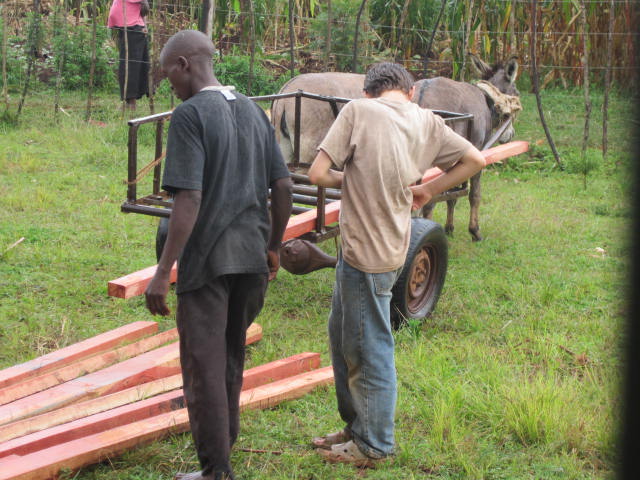
Yes, those are donkeys. Expect the unexpected!
Immunizations, Prescription Drugs, and GMO

While in America, we ran in some pretty conservative homeschooling circles. Although we never did go the “no-immunization” route with our children, I certainly was swayed toward that position, and Marc and I had many conversations about it. We did “delay” some immunizations for some of our children and refused the chicken pox vaccine almost across the board (although our oldest got it). I won’t deny the stranglehold that the pharmaceutical industry has on many facets of life in America, and I would even give some credence to the link between immunizations and autism.

So when we had been in Africa only a few months and two nice doctors showed up in our yard telling us that we needed to have all children under 5 given an oral vaccine for polio because there were some confirmed cases not too far away, I was adamant that WE DID NOT NEED THEM. They’d already been vaccinated in America, and no further intervention was necessary (for our protection or theirs). They were equally adamant that THEY ROUTINELY RE-VACCINATED ALL CHILDREN UNDER FIVE WHENEVER THERE WAS A CONFIRMED CASE OF POLIO IN THE AREA. Seeing that they would not be moved, I summoned Marc and he told me to dig their immunization records out of the file. Done. He showed the nice doctors our paperwork and they retreated.

An hour or so later, a couple more nice doctors came. These were higher up the supervisory chain, I think, and they would not be deterred from their mission. Marc conceded, and three of our littles got some drops in their mouths. I made a weak protest to Marc after they left, but all he said was, “You can’t blame them. Polio IS a really scary disease. I’ve been into Kitale more than you, and I’ve seen several people crippled and laying on the sidewalk begging. That’s all they can do. I’m pretty sure that’s from polio. They have to take it seriously and they don’t want us to be a risk.”

Good point. I suppose in America, we have the luxury of choice. Here, where the disease is not eradicated, they are trying to get to where we are–a total population free from the fear of a crippling disease. I  had not thought of it that way.

Ditto for prescription medication. We were on the path toward total natural remedies–in fact, I’m thinking we actually had arrived there. We haven’t been to the doctor (other than children’s preventative visits) or gotten a prescription for…a long time. I preferred oregano and grapefruit seed extract to any artificial antibiotic and believed they were equally as effective. For coughs, a rub of eucalyptus and thyme mixed with a carrier oil or a homemade cough syrup would do the trick. Immune-boosting supplements kept us healthy enough not to need further interventions, as a rule.

Then…Africa.

Water-borne amoebas stubbornly resisted all oregano and grapefruit seed extract, probiotics, and whatever else I could throw at them. So, in defeat, we talked to the neighborhood chemist, who have us some pills and some oral meds for the littles. We’ve all taken them multiple times, and each time I choose to be thankful for the relief rather than suspect of the chemical processes behind it. Many of our neighbors who routinely get malaria are grateful for cheap anti-malarial drugs–who can blame them? And when our 11 year-old had a bad cough that kept him up for multiple nights, unresponsive to our homemade cough syrup and chest rub, well…I took as a blessing the allergy medicine and cough suppressant from the local chemist.

And despite the evidence against GMOs (with which, by the way, I generally agree), I can see why the locals here use it without any second thought. Where a child reaching the age of five is a monumental milestone (due to disease and, yes, starvation), getting twice the yield (or more) from GMO versus heirloom corn seems pretty appealing. Better to be able to feed your children then potentially have them die of starvation, even if the GMO stuff does give them cancer…or sterilize them for life…or whatever *might* happen from a lifelong exposure to such an altered food source.

We’ve never been the type to make a stand over any “debatable” issues. The Gospel of the Kingdom is where we stand firm, and in all other things we do have an opinion, but unless asked we try to keep it to ourselves. If we do share what we believe, we try not to be dogmatic, but give room for freedom to our Christian brothers and sisters. But in these areas–immunizations, prescriptions drugs, and GMO–I recognize that I did have very firm convictions. And now, while I’m not second-guessing that, I do see how sometimes, we don’t have the luxury of conviction. And unless it involves obedience to Christ, maybe our opinion is, in the final analysis, irrelevant.

Oh, and yes, raw milk is best and people should have freedom to choose between that and the pasteurized variety. Here we have that freedom, but until the day we get our own cow…I’m boiling my milk, thanks.


“The Kingdom of God is not about Eating and Drinking…”

I’m not sure why, but a lot around here revolves around food. I keep quoting to the children, “The Kingdom of God is not about eating and drinking but about righteousness, peace, and joy in the Holy Spirit!” (Romans 14:17), but it seems that no sooner do we finish breakfast than one or more of them is asking what’s for lunch. While around the supper table, how quickly a conversation moves from Dad’s mission that day to how much we would love a McDouble from the Dollar Menu at McDonald’s. *Sigh.*

Previously, I shared some thoughts on what we’ve been eating since coming to Africa. And for some reason, my mind has been ruminating on food again lately. At first, I was happy with how much (comparatively) simpler things were as far as our diet is concerned, and that’s still true. However, we’ve also made some changes that I’m not sure I like so much.

Quite a while ago (still in America) I decided to switch from margarine to butter…just felt it was healthier, for a variety of reasons. Now here, we’ve switched from butter to margarine. Why? Well, to get butter we have to travel all the way to Kitale, which doesn’t happen that frequently. And without refrigeration, I don’t think it’s practical to expect to keep butter fresh for that long between trips. Then there’s cost (butter is expensive and we’re pinching our grocery pennies a little more than we used to). I suppose we could just eliminate butter from our diet, but…that’s hard!

Also, corn…of the GMO variety. It’s plentiful and cheap. Many Africans eat ugali (essentially cornmeal mush) three meals a day. In fact, “it’s not a meal without ugali!” seems to be the general sentiment. So, to be here and NOT eat ugali would really set us apart. Even though we’ll always be mzungus in Africa, there’s some truth to the saying, while in Rome, do as the Romans do. I don’t think there’s ANY non-GMO corn here, so we’re eating what they eat. We certainly don’t eat ugali every day, but a couple of times a week has become the norm. Something else I don’t particularly like, but…what to do?

And then there’s oil. People here don’t use oil, they use “cooking fat,” which actually is vegetable shortening. Another thing I’d streamlined out of our diet in America, in favor of healthier coconut oil. Getting coconut oil here? I don’t think we can…and if it were available, I’m quite sure it would be out of our budget in the amount that we use it. So, for lack of alternatives, we’re back to vegetable shortening.

Another preference of mine was apple cider vinegar over the distilled white variety–many health benefits there. And I was surprised to find that even white vinegar is rare here. What you usually find is a cleverly labeled vinegar substitute, which is just water and acetic acid. Even that is not particularly cheap.

Flour…used to be whole wheat only, and ground fresh at home. Now, white flour. Cheaper and easier. The wheat berries here are so dirty that I haven’t committed time to clean them in addition to the beans, corn and rice that we use on a daily basis. The last wheat bread I made actually tasted dirty, even though the wheat berries were cleaned as well as I was able. Bleck!

So for as many health benefits that I believe there are about living in this part of the world, there are just as many sacrifices that I feel we are making. Trying to find a good balance in this area has been difficult. We’re doing the best we can to be good stewards of our health, and there’s much that is out of our control. But, I figure, God is faithful and we’ll be around on this rock for as long as He wants us to be.  So, it’s all good…


“It’s Just that I was Right in the Middle of my Chapter…”

Mornings are always busy here. We all get up early and, like it or not, seem to hit the ground running. Jobs, breakfast, usually more work, and then schooling. I try to balance the kids’ busy-ness with some little “breaks” built in, but sometimes there’s just too much to do!

When the children first get up, they’re expected to make their beds and get themselves presentable for the day, then have some Bible time or quiet reading time until we are all ready for family devotions. Lately, one of my children in particular has been absorbed in a personal reading book that apparently has been very captivating, so when we’ve asked them to “put the book down” to do the next thing, we’ve been met with a rather sour attitude in response. Unfortunately, the overtone tends to permeate the rest of the morning’s activities. Much gentle encouragement and prayer have been the general prescription, and usually after a while I get a hug and and apology.

Today, more of the same. After trying to get the kids to pitch in and work together to clear the table (while each one wanted to just do their own thing and let everyone else shoulder the burden), I assigned morning jobs and got some flack from said child who lately has been struggling to have a positive attitude about work responsibilities. After a short conversation (in which I didn’t really feel like being kind, but forced myself to anyway), the child said to me, “I’m sorry I had a bad attitude. It’s just that I was right in the middle of a chapter!” To which I could only express my agreement, because I’ve felt similar frustrations in being interrupted. Another opportunity to be reminded of the power of sympathy.

It has seemed to me that this particular child has had a bad attitude about work, and I’ve been trying to address it as such. Yet all the while I was missing the mark with my encouragements because I failed to see the “root cause.” It wasn’t laziness, as I assumed…it was just frustration in not getting to finish something started. Granted, we all must learn to sacrifice our personal preferences and serve others in love…but that is a process, isn’t it? So my lesson this morning is this: just as I need to address the “root causes” in my own spiritual growth in order to see victory, in the same way I need to commit my children to prayer and seek wisdom so that I can identify the root causes that drive their behavior, and address them effectively. Something else that I suppose I knew, but needs a reminder every once in a while.

(And, the “5-minute warning” prior to a change in activity never hurts, either. I tend to forget about that, too…)

I “Knew,” but I had no Clue…

When we were preparing to move to Africa (a place where Marc had been several times, but I…never), I knew something about it. I saw pictures, heard stories, and got some common-sense advice and encouragement from folks who had taken the journey ahead of us. So I knew something about what to expect, and as best as I was able, I was prepared.

But in so many ways, Africa has been a surprise. And though I was prepared, and the transition has gone well, I have been meditating lately on the difference between “knowing” and actually experiencing.

When I explain to women the change that the Lord has worked in me spiritually, I tell them that for many years of being a Christian, the message of the Gospel was informational but not transformational. Moving to Africa has been somewhat the same. I was prepared…but actually living out the realities of what I was mentally prepared for has transformed me in many ways. And I am sure the process is not yet finished.

For example, I knew I would be doing laundry by hand. I had some idea of how to do it and what it would be like. But actually using up 2-3 precious hours each day to fill up almost three full lines of clothes has changed me in ways that, if I actually tried to explain it, would probably seem silly. I knew we would be simplifying our diet…but if you had told me that there would be some days that I would give anything for a hotdog or a soft-serve ice cream cone, I would have laughed. Because, after all, I “knew” that following Christ came with sacrifices…I was (at least mentally) prepared for that…and I also “knew” that we are not of this world and that we should set our minds on things above and that if anyone loves the world, the love of the Father is not in him. But actually living those words? Transformational.

There is a wide chasm between information and transformation. Believing is one thing, and living what we believe is entirely another. But if we truly believe, it should, indeed, change the way we live.

“Cans, eh?”

One of the things we brought with us to Africa is our canning supplies. We were told that it is impossible to procure canning jars and canning pots here; people just don’t use them. I can understand why. With a practically year-round growing season, why would you? Not only that, but the amount of fuel required to pressure can (or even water bath can) is beyond the budget of most folks. Thus, dried everything: corn, beans, peas, mushrooms, etc.

But I have to admit, we mzungus like the flavor of fresh. And this mzungu Mama likes the ease of opening a couple of cans and having dinner 2/3 ready, versus spending the day cleaning, soaking, and cooking something…dry. Last but not least, the mzungu palate is a little more varied than that of the locals–we appreciate french beans (commonly called “green beans”), tomatoes, and sweet corn. Sweet corn is unheard of, and green beans and tomatoes are not always in season–and when not, they are more expensive than other food items.

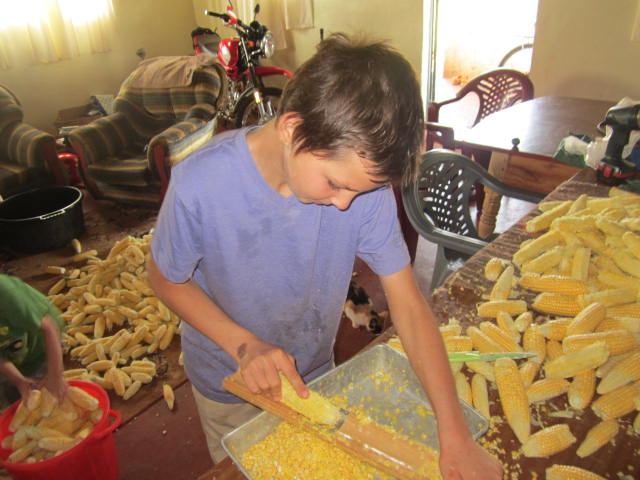
We probably didn’t know it when we packed our gear, but as much as canning is certainly a novelty here, we are really going to appreciate having the technology at our disposal. We have recently bought 39 kilos of french beans for…very cheap…because they are ready and there’s not much market for them among the locals. Those who grow them want to sell them before the crop is spoiled. As well, just yesterday we harvested our crop of sweet corn–yum!! We’re looking forward to tomatoes, but…not yet.

In any case, we’ve already canned 42 quarts of beans and between yesterday and today, the same amount of sweet corn, plus an additional amount of beans.

People keep dropping in to see the process—they are quite intrigued. When we tell them that cans can keep food fresh on the shelf for…years…the typical response is, “Eh?!” (“Eh?” is a general expression of surprise or disbelief.)

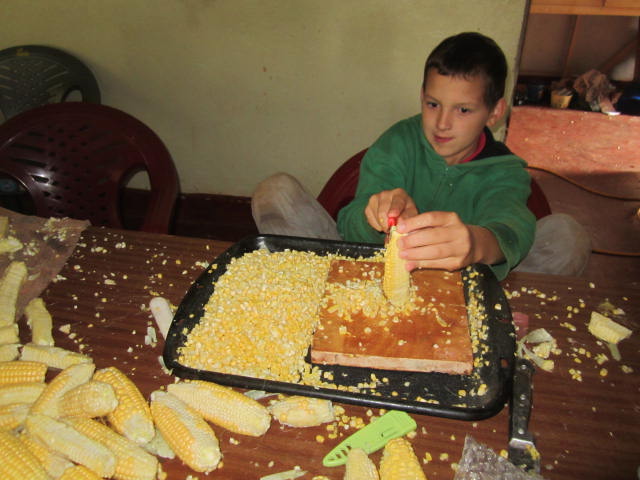
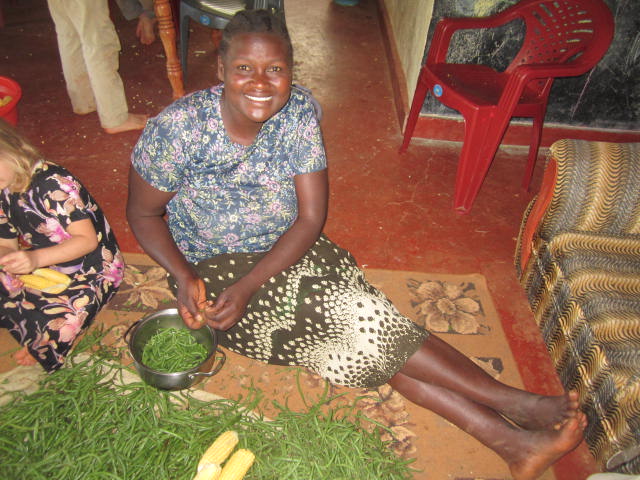
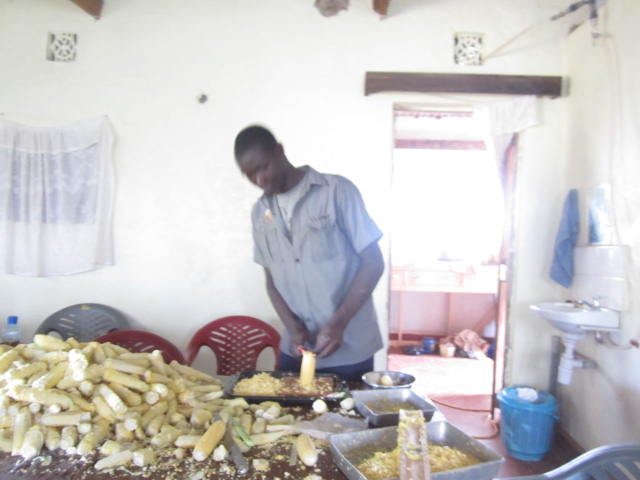
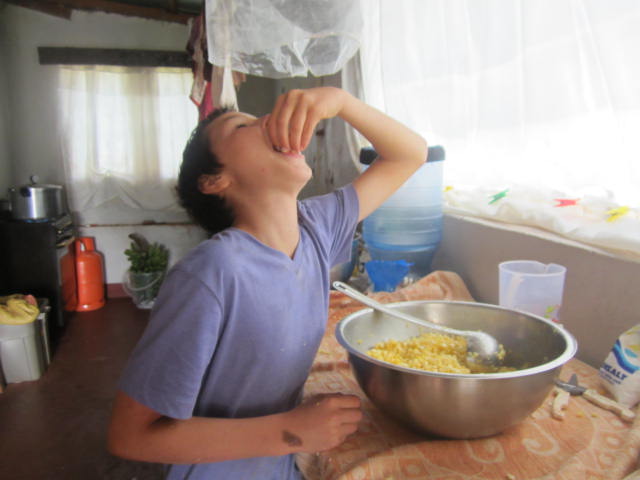
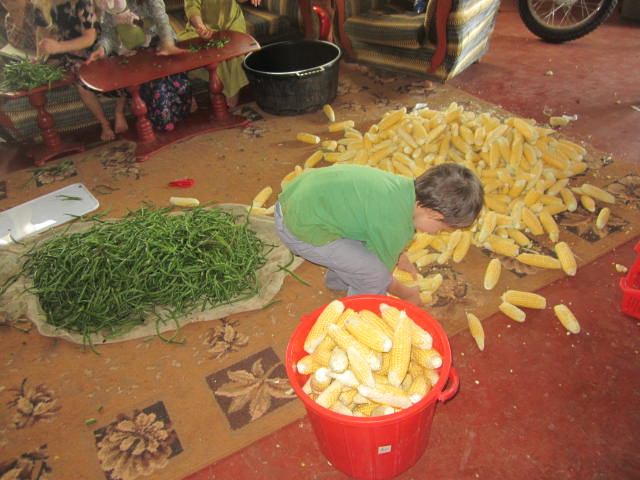
Here are some photos from our work today:

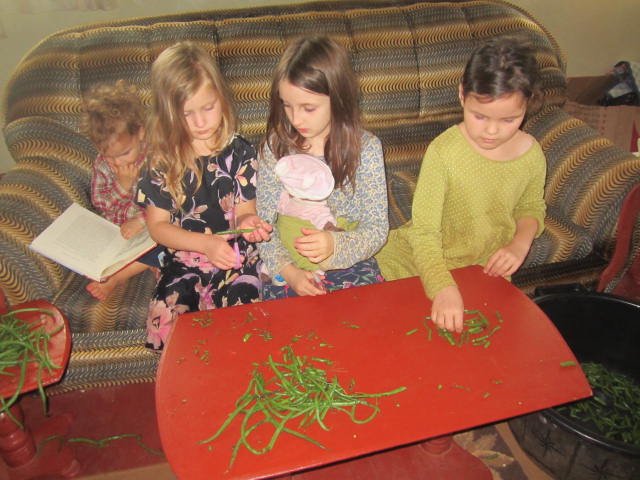
Big girls snipping beans

Boys hard at work on corn


Rose and her son, Georgie, stopped by for a visit and stayed to help

“the Scripture says, “ You shall not muzzle the ox while he is threshing,” and “ The laborer is worthy of his wages.” (1 Timothy 5:18)

Micah hustling to bring more corn to the big boys

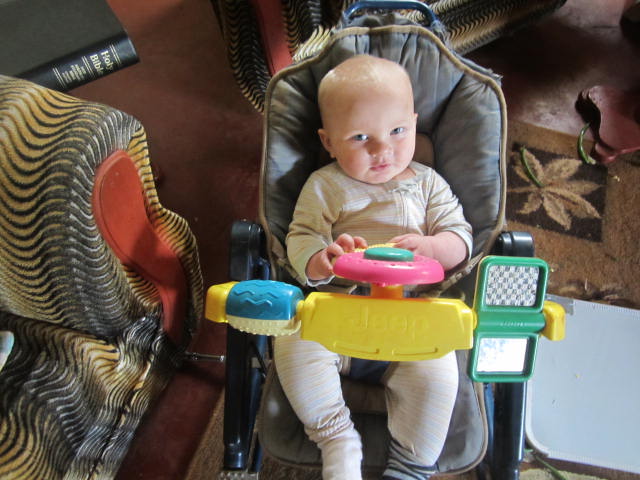
Cute baby…observing for now…but just wait!

The Power of Sympathy

Historically, we haven’t been perfect at encouraging our children. We talk about that in our book, The Values-Driven Family:

We both grew up in homes where we knew we were loved; our parents did their very best in every way to bring us to adulthood successfully. Yet we both also would say that we grew up in an environment that leaned toward the critical. Whether reality or simply our own perception of things, we constantly felt like we had to “measure up,” and if we failed we felt a certain condemnation. This somewhat negative overtone to our family lives, however, didn’t really become obvious until we prayerfully considered our own shortcomings as parents. It was then that we saw that we were perpetuating this learned pattern of parenting, and propagating a spirit of discouragement rather than encouragement. As a result, our best efforts in training, discipline, and even relationship-building were falling short.

(p. 18)

We talk about a few ways that we’ve tried to overcome this deficiency, the least of which was to implement the use of the Core Value Chart (more about that and a free copy here). Developing healthy and loving relationships with each of our children has also been important–but I won’t deny that we’ve had our struggles there, too.

Personally, I’ve become convicted over time that not only is encouragement necessary in relationships, but so is sympathy. Not the artificial kind that comes across as being condescending, but a true desire to connect and understand. I reflected on this yet again this morning as I read from the book of Hebrews in my quiet time:

For we do not have a high priest who cannot sympathize with our weaknesses, but One who has been tempted in all things as we are, yet without sin. Therefore let us draw near with confidence to the throne of grace, so that we may receive mercy and find grace to help in time of need. (Hebrews 4:15-16)

True sympathy can mean giving a hug at just the right time. Perhaps, like the friends of Job, we sit in silence when words will get in the way. I find that I often express sympathy by sharing my own similar struggles or stories from my past–and I end by simply saying, “I understand.” This is my favorite way to express sympathy, because then I get to take the next step and share how the Lord has strengthened me or helped me to overcome, or I can express how I’ve experienced His comforting presence during difficult times. This is not only good for our family relationships, but it is also an excellent discipleship opportunity as we strive to help our children grow closer to the Lord.

I need the Lord to give me gentle reminders in this area quite often, because it’s easy to lose sight of sympathy in the everyday hustle-and-bustle of life. Think on these things today, and don’t forget to extend mercy to your children and give grace to help them in their time of need.

Interlude

Seems like we’ve been going a mile a minute since moving to Africa. First, just settling in and getting used to a lot of new routines and ways of doing things (not to mention geography, culture, and so on). Then, figuring out how to balance ministry with life, since there are more opportunities than we can reasonably take advantage of–invitations to teach, discipleship meetings, community interactions, drop-in guests, and even short-term missions visitors. And finally, trying to wrap up our school  year before a new one gets started!

Last week I (Cindy) had scheduled a trip with two ladies whom I’ve been discipling, to speak to a group that was eager to hear more about the Gospel of the Kingdom. I’ve been making more of such trips than I had anticipated, and I was suddenly feeling burdened about being gone most of the day, leaving my still-nursing baby and many things at home that I wanted to attend to. As well, I can see (in various ways) that I have not been giving some of the children the attention they need. I talked to Marc about my concerns, and the questions I had about what a woman’s role in “ministry” is, and how to balance these various aspects of life.

Marc decided to step in and talk to the other two ladies that I was to have gone out with; he explained the situation and told them that for now, I would be re-focusing on things at home and that they could continue with any group meetings or teachings that we had previously planned. I think this is very healthy for them, as they will gain confidence in sharing the Gospel, answering questions, and actively making disciples. I trust that God will continue to open doors for ministry that He wants to see me participate in, but in the mean time I am taking a needed break and working on that discipleship process with my own children at home–something that I feel has been to much neglected lately.